Ten of Swords Tarot Card Meaning
The Ten of Swords symbolizes a painful ending, mental overload, or the recognition that an approach is no longer sustainable. Reversed, it can suggest gradual recovery or difficulty accepting closure. Neither position proves that something terrible will happen or that a difficult situation is already safe. The useful question is not “What disaster is coming?” but “What do I know about this situation, and what support or boundary would help?”
This is a dramatic card, but dramatic imagery is not a literal forecast. A draw cannot establish betrayal, diagnose illness, predict death, or determine whether a relationship must end. Read its themes alongside your question, the actual circumstances, and any assigned position in the spread. If you drew it without a question, use it as a reflection on endings or overload rather than evidence that a hidden crisis exists.
Symbolism and Traditional Associations
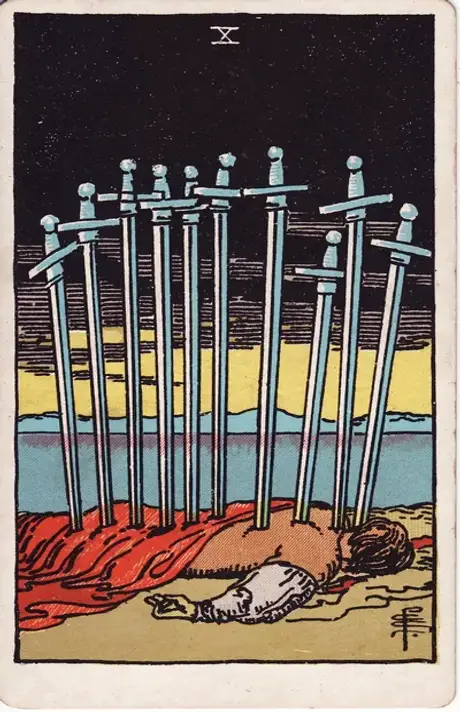
In the Rider-Waite-Smith image, a figure lies beneath a dark sky with ten swords across their back. A brighter horizon contrasts with that darkness. The contrast is often read as an image of closure and the possibility of a different chapter, not a timetable for recovery. The number ten brings a numbered suit sequence to its limit; it does not measure the amount of suffering a person can experience.
The suit of Swords is traditionally associated with Air: thought, language, decisions, and conflict. The Sun in Gemini is a correspondence used in some tarot traditions, not a fact about your birth chart or another person’s motives. You do not need astrology to read this card. Its more immediate themes concern what has become mentally exhausting, what has actually ended, and what you can stop carrying alone.
| Context | Upright focus | Reversed focus |
|---|---|---|
| General reflection | A limit, conclusion, or feeling of defeat | Rebuilding, incomplete closure, or resistance to change |
| Love | A painful pattern or boundary worth examining | Repair after hurt, or difficulty releasing a pattern |
| Work | An unsustainable approach or disappointing outcome | A cautious reset with practical support |
| Useful question | What evidence shows that something needs to change? | What would a realistic next step in recovery look like? |
Upright Meaning
Upright, the Ten of Swords can name the feeling of having reached a limit. That limit might relate to a project, an argument, an expectation, or a way of interpreting events. It is not always an entire relationship or career. Start by identifying the scale of the question: a card drawn about one difficult conversation should not automatically become a verdict on your whole life.
One reading is acceptance of an ending that has already happened. Another is recognition of a thought pattern that treats a setback as total defeat. These possibilities call for different responses. An actual cancellation may need practical reorganization; a fear that everyone has rejected you may need a check against the facts. The card alone cannot tell you which situation applies.
Rather than assuming that nothing worse can happen, ask what is within your control today. You might stop rereading an upsetting message, clarify a deadline, or request help with a task. Acceptance does not mean approving of harm, abandoning your rights, or refusing further support. It means making decisions from the information you have instead of treating the image as an instruction to surrender.
Reversed Meaning
The Ten of Swords reversed is commonly read in two ways: beginning to rebuild after a difficult experience, or struggling to accept that an old approach needs to end. These are alternatives to explore, not two facts that must both be true about you. Your circumstances and the spread position determine which, if either, is useful.
Recovery may be quiet and uneven. A practical sign could be asking for support, returning to a manageable routine, or seeing more than one possible response to a problem. The reversal does not certify that danger has passed, that another person has changed, or that you should resume a situation that felt unsafe. Look for observable change before making that decision.
If resistance to closure fits better, ask what makes letting go difficult: uncertainty, money, shared responsibilities, or attachment to an expected outcome. Those concerns may deserve planning rather than a motivational slogan. A reversed card is not automatically positive, just as an upright card is not automatically negative. The distinction is where your attention goes: acknowledging the limit, or working with what follows it.
Love & Relationships
Ten of Swords Upright in Love
In a love reading, this card can help explore hurt, disappointment, or a repeated conflict. It does not prove that a partner is cheating, that an ex has particular feelings, or that a breakup is inevitable. If a relationship has already ended, the symbolism may support reflection on closure. If it has not, avoid inventing an ending simply because the card looks severe.
Try a question grounded in your own agency: “What boundary do I need to express clearly?” or “Which part of this pattern is within my control?” Separate something a person actually said or did from your interpretation of it. A conversation can provide information that a draw cannot. Where there is coercion or abuse, prioritize real-world safety and appropriate support rather than using tarot to decide whether to stay.
Ten of Swords Reversed in Love
Reversed, it may invite reflection on rebuilding trust or finding closure after hurt. Reconciliation is only one possible context and is not promised by the card. Repair requires willing participation, changed behavior, and boundaries; hope alone is not evidence that those conditions exist. You can also move forward without restoring the previous relationship.
For a broader reflection, try the free love tarot reading with a question about your own choices. Treat the resulting cards as prompts, not access to another person’s private thoughts. Single readers do not need to interpret this card as proof of hidden romantic damage or a prediction about the next person they meet.
Career & Finances
At work, the upright Ten of Swords may symbolize frustration with a failed proposal, an exhausted routine, or an approach that has stopped helping. It does not forecast dismissal, business failure, or bankruptcy. Before making a major change, check the relevant facts: expectations, feedback, workload, contract terms, and available alternatives. A disappointing meeting and an actual job loss are different situations.
Reversed, consider what a modest reset would involve. That could mean documenting lessons from a project, discussing a realistic workload, or updating one part of a job application. If the theme is resistance rather than recovery, identify the cost of continuing unchanged and the support needed to try something else. Avoid treating “start over” as a demand to resign immediately.
Money questions require records and qualified advice where appropriate. A card cannot determine investment performance, debt outcomes, or whether a financial arrangement is safe. The career tarot tool can support reflection on priorities, but use budgets, written terms, and professional guidance for consequential financial decisions.
Health & Wellness
The Ten of Swords cannot diagnose a condition, establish the severity of symptoms, or tell you whether medical danger has passed. Its imagery does not mean physical death. An upright or reversed draw also cannot confirm that treatment is working or that it is time to stop medication. Those questions belong with a qualified healthcare professional.
For non-clinical reflection, the card may prompt you to notice whether a schedule feels overwhelming or whether you would benefit from asking for support. That is different from claiming you have an illness, trauma, or a particular mental-health condition. Let your own experience guide what is relevant instead of trying to fit yourself to the card.
If you have worrying symptoms or concerns about your safety, seek appropriate real-world help regardless of the draw. Repeatedly pulling cards for reassurance can create more uncertainty. Pause the reading if it is increasing distress; you do not need a more favorable card before taking care of yourself.
Yes or No
TarotWise classifies the Ten of Swords as Maybe. This is a symbolic convention rather than a calculated probability. Some readers lean toward “no” when a question concerns continuing an exhausting pattern, but that does not turn the card into reliable evidence about a future event. Reversed is not an automatic “yes,” and neither orientation guarantees improvement.
Make the question specific and practical before using the yes or no tarot reading. “Should I clarify the expectations before continuing?” gives you more to reflect on than “Will everything be okay?” For a high-stakes decision, identify the information you still need and use tarot, if at all, as a secondary reflection exercise.
Key Combinations
Ten of Swords + The Sun: This contrast can frame a reflection on disappointment and clarity. Ask what becomes easier to understand when you name what did not work. It does not guarantee a happy ending. Explore The Sun for its distinct themes rather than treating it as a cancellation of the first card.
Ten of Swords + Ace of Wands: A perceived ending and a new idea can coexist. You might consider a small experiment without denying the difficulty of what came before. The combination is not an instruction to make a risky change immediately. See the Ace of Wands for a fuller discussion of initiative and potential.
Ten of Swords + Death: Both can raise themes of endings, but they are not interchangeable. The Ten emphasizes the experience of reaching a limit; Death often concerns transition and release. Neither predicts literal death. Read the assigned positions before assuming that two ending-themed cards make an outcome more certain.
How to Read This Card in Context
- Restate the question. Note whether it concerns a known event, a decision, or a general reflection. If there is no question, avoid adding an invented personal history.
- Record the orientation and position. An advice position asks how to respond; a challenge position asks what needs attention. A free draw has no automatic past-present-future timeline.
- Separate facts from associations. Write one observed fact beside one symbolic possibility. Keep them separate rather than letting the second replace the first.
- Choose a proportionate next step. Clarifying a concern or asking for help may fit better than a dramatic decision. Define a step you can actually take without relying on a prediction.
For example, imagine a canceled project and an upright Ten of Swords in an advice position. An illustrative interpretation is to acknowledge the cancellation, request useful feedback, and decide which materials can be reused. It is not evidence that the entire career is over. With the same card reversed, the emphasis might shift toward a manageable restart or difficulty releasing the original plan.
Use a three-card spread when named positions would help organize the question. In a tarot journal, record what you actually did afterward and what you learned, rather than collecting apparent proof that a prediction came true. The aim is a clearer reflection, not certainty about events a card cannot establish.
Frequently Asked Questions
What does the Ten of Swords tarot card mean?
The Ten of Swords is a Minor Arcana card from the Suit of Swords. Its core meanings include painful ending, mental overload, limits, closure. Read the upright or reversed position together with the question and surrounding cards.
Is the Ten of Swords a yes or no card?
The Ten of Swords generally gives a "maybe" answer in a yes or no tarot reading. The question, card orientation, and surrounding cards can refine that answer.
What does the Ten of Swords reversed mean?
The Ten of Swords reversed is associated with gradual recovery, rebuilding, resisting closure, seeking support. Apply these themes to the specific area of the reading, such as love, career, finances, or personal growth.
What suit does the Ten of Swords belong to?
The Ten of Swords belongs to the Suit of Swords, which is associated with the element of Air. This suit deals with intellect, conflict, and truth.