
A tarot journal is a record of your questions, drawn cards, interpretations, and later observations. It can help you learn card meanings and notice how you frame decisions. It does not establish that cards predict events or reveal another person’s private thoughts.
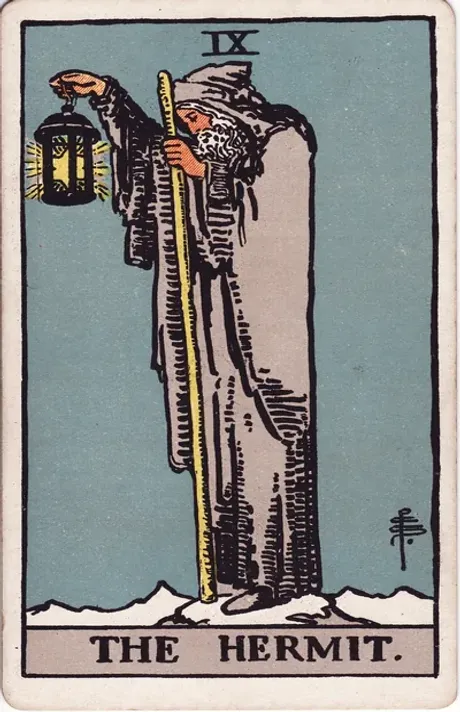
What to record in a tarot journal
Use a notebook, a private document, or a reading archive. A special printed journal is optional. Choose a format you can revisit without rewriting your first impression after the fact.
| Field | What to write |
|---|---|
| Date and question | Your exact question before drawing, not a revised question fitted to the result |
| Context | Only facts you already know; mark assumptions separately |
| Cards | Names, upright or reversed orientation, and draw order |
| Positions | Labels chosen before drawing; leave blank for a free draw |
| Possible interpretation | One or two card-linked themes, phrased as possibilities |
| Alternative | Another plausible reading, or why the interpretation might not fit |
| Small action | Something reversible and within your control |
| Review date | A time to return to this entry and record observations |
Check unfamiliar cards in the complete card meanings library. Keep the reversed meaning distinct from the upright meaning. A reversal is not automatically bad, and an upright card is not proof that everything will be easy.
A reusable tarot journal template
Date:
Question asked before drawing:
What I know / what I am assuming:
Cards, orientations, and predefined positions:
My first impression:
A card-linked possibility:
An alternative explanation:
One small action I can choose:
Review date:
What I later observed, including what did not fit:
For a first entry, a single-card draw is enough. You do not need a complicated layout or a paid report. If your question needs several perspectives, choose the positions before using a three-card spread.
Worked example: one card and one practical question
This is an illustrative journal entry, not a customer story or a prediction.
Question: What can I try when I keep postponing my study session?
Known context: I planned two sessions this week and did not start either. I have not yet checked whether the sessions were too long or poorly timed.
Card: Eight of Pentacles, upright. No position label was assigned.
Possible interpretation: The Eight of Pentacles is associated with practice and attention to a skill. I could use that theme to examine whether my plan has a clear, manageable first task.
Alternative: The problem might be my schedule or the study material, not a lack of commitment. The card cannot tell me which explanation is correct.
Small action: Choose one exercise and try ten minutes at a realistic time. Afterwards, note what helped and what got in the way.
Review: At the end of the week, compare the plan with what happened. Keep the entry even if the interpretation was not useful.
Notice that the action follows an observable question. It does not turn the card into evidence about your character or a guarantee of progress.
Prompts for daily and weekly reflection
For a short daily entry, select one prompt rather than answering every question:
- Which detail of this card drew my attention, and what does it remind me of?
- What did I bring to this reading before I saw the card?
- Which part of my interpretation comes from known facts?
- What is one other way to understand this theme?
- What small experiment would give me useful information?
At a weekly review, ask:
- Which entries gave me a practical question to explore?
- Where did I mistake an assumption for a fact?
- Which readings did not fit, and did I record that honestly?
- Am I repeatedly asking for reassurance about the same uncertainty?
- Would a conversation, practical research, or professional advice be more useful here?
The questions to ask tarot cards guide offers ways to turn broad questions into reflective prompts. A daily tarot card can supply a consistent starting point, but there is no requirement to draw every day.
Avoid hindsight and repeated reassurance
Write your interpretation before you know an outcome. During review, add a new dated note instead of silently changing the original. Record mismatches as carefully as apparent matches. A familiar theme appearing repeatedly is not evidence that an event is destined to happen.
If you feel compelled to keep drawing until an answer feels reassuring, pause the reading. For relationship questions, record what was actually communicated rather than using the journal to infer another person’s feelings. For medical, legal, or financial decisions, use qualified advice and observable information.
Keep your journal private
Use initials instead of other people’s full names and avoid storing payment details, identification numbers, or sensitive third-party information. On a shared device, a local reading archive may be visible to the next person using that browser. Browser storage is not a secure backup and may disappear when browsing data is cleared.
Keep an independent copy of entries that matter to you. Cloud storage and account-linked reports have separate access and retention rules described in the privacy policy.
Common questions
What is a tarot journal?
A tarot journal records your question, cards, orientations, interpretation, and later observations. It is a tool for learning and reflection, not a record of proven predictions.
What should I write in a tarot journal?
Record the date, the exact question, each card and orientation, any predefined positions, a possible theme, one alternative interpretation, a small action, and a review date. Keep facts separate from symbolic interpretation.
Do I need to buy a special tarot journal?
No. A notebook or a private digital note is enough. A printed journal may help with consistency, but prompts and space to review matter more than the format.
How often should I review tarot journal entries?
A weekly review is a manageable starting point. Compare your original words with what you actually observed, including interpretations that did not fit. There is no required schedule.