Seven of Swords Tarot Card Meaning
The Seven of Swords represents strategy, discretion, avoidance, and the ethical cost of taking a shortcut. Upright, it invites you to examine how information and responsibility are being handled. Reversed, it can suggest reconsidering a plan, communicating more openly, or questioning an assumption. Neither orientation proves that someone is lying, cheating, or about to be exposed.
This distinction matters because the card’s dramatic imagery can make an uncertain situation feel like a solved mystery. A tarot draw does not reveal another person’s private behavior. Use this card to frame better questions about choices you can observe, not to turn suspicion into a conclusion. Its useful question is often: “What do I know, what am I assuming, and what would a responsible next step look like?”
Upright and Reversed at a Glance
| Context | Upright | Reversed |
|---|---|---|
| General | Review your plan | Rethink your approach |
| Love | Discuss boundaries | Seek clearer dialogue |
| Work | Check consent | Correct an error |
| Decision | Check the facts | Question assumptions |
| Limit | Not proof of lies | Not a promised reveal |
Imagery and Symbolism
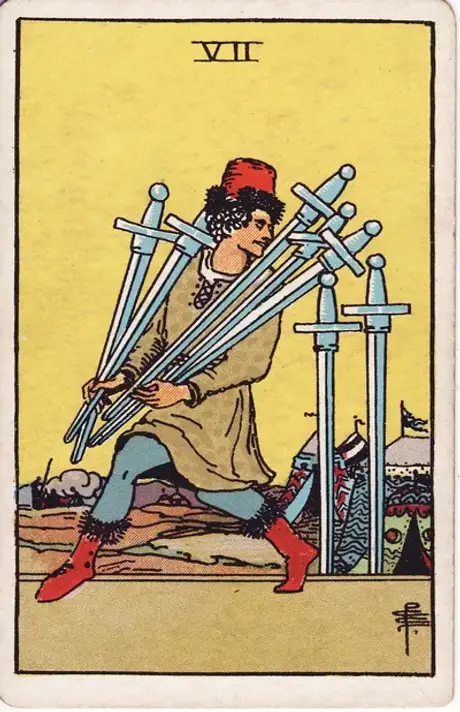
In the familiar Rider-Waite-Smith image, a figure carries five swords away from a camp while two remain behind. The backward glance, uneven load, and distant tents create a visual tension between individual action and collective responsibility. The scene is commonly read as stealth or deception, but it can also prompt questions about independence, incomplete plans, and the consequences of leaving something unresolved.
The picture offers a symbolic vocabulary, not evidence about your own life. Carrying more than can be managed might become a question about an overcomplicated strategy. Leaving two swords behind might prompt you to consider an unfinished obligation. The camp can represent a group agreement worth clarifying. These are possible interpretations to compare with your circumstances, not facts the image establishes.
The suit of Swords is associated with Air: thought, language, decisions, and perspective. Some tarot traditions associate this card with the Moon in Aquarius. Those correspondences are interpretive conventions rather than scientific explanations of behavior, and not every deck or reader uses the same system. Start with the actual artwork and the question rather than assuming a correspondence settles the meaning.
Seven of Swords Upright Meaning
Upright, the card asks how a goal is being pursued. There is a meaningful difference between planning privately and concealing information that another person needs in order to consent. Preparing a proposal before sharing it may be reasonable discretion. Claiming a colleague’s work as your own is a different ethical question. The card invites that distinction; it does not tell you which situation exists.
Independence is another possible theme. You may want to explore whether working alone would simplify a task or merely avoid a useful conversation. A private first draft can be constructive, while refusing all feedback can leave an important weakness unexamined. Consider what you can genuinely decide yourself and what requires agreement from someone affected by the decision.
Shortcuts deserve the same careful treatment. A more efficient method is not automatically dishonest. The relevant questions are whether it changes the risk, hides an obligation, or transfers a cost to someone else. Instead of asking whether the card labels you or another person “untrustworthy,” ask which part of a plan needs a clearer explanation.
For a practical reflection, separate three things on paper: what has been directly observed, what remains unknown, and what you can reasonably ask. A concern can deserve attention without being proven. Avoid treating repeated draws as corroboration; drawing the card again does not add independent evidence. A tarot journal can help preserve that distinction rather than turning every later event into confirmation.
Seven of Swords Reversed Meaning
Reversed interpretations often emphasize accountability, a change of strategy, or greater openness. You might consider whether a difficult but proportionate clarification would be more useful than continuing an elaborate workaround. This can be as ordinary as correcting an inaccurate message or explaining that an earlier deadline estimate was unrealistic.
Another interpretation concerns assumptions rather than secrets. A story can feel convincing because it is familiar or emotionally compelling. The reversed card can invite you to test that story: what would count against it, and what information would you need before acting? This is especially useful when your question already assumes wrongdoing that has not been established.
Some readers interpret the reversal as increased avoidance rather than its resolution. These meanings are alternatives, not simultaneous diagnoses. Choose the interpretation that fits the supplied question and observable circumstances, and explain why. If neither fits, it is reasonable to leave the card’s meaning open instead of inventing an incident to make it relevant.
Traditional keywords such as confession or exposure describe themes, not guaranteed events. The reversal cannot promise that a secret will emerge, that an apology will happen, or that trust will be restored. An honest conversation may be useful, but its outcome depends on real choices and circumstances. Accountability means taking responsibility for your own conduct, not demanding a confession because a card appeared.
Seven of Swords in Love and Relationships
Upright in Love
The upright card can be a prompt to discuss privacy, expectations, and the difference between a concern and an accusation. It is not a cheating detector. A delayed reply, an ambiguous message, or a tarot symbol does not establish infidelity. Ask what you have actually observed and whether the expectation involved was ever clearly discussed.
If you are getting to know someone, useful questions might concern availability, communication preferences, or what each person wants from dating. If you are in a relationship, consider whether there is a specific agreement that needs clarification. Keep those suggestions conditional: the card itself does not establish that you have a partner, that a boundary was crossed, or that another person has a hidden motive.
Reversed in Love
Reversed, the card can invite reflection on what more direct communication would look like. You might choose to correct something you said, acknowledge uncertainty, or ask an open question without deciding the answer in advance. Rebuilding trust, where a real breach has occurred, requires sustained behavior and consent; no orientation guarantees reconciliation.
A love tarot reading can help organize reflection around your own choices. It cannot verify another person’s feelings or substitute for a conversation. Do not use this card to justify checking private messages, monitoring someone, or confronting a person who may be unsafe. If there is abuse, coercion, or immediate danger, prioritize qualified local support and safety rather than further divination.
Career and Money
At work, this card can prompt practical questions about ownership, attribution, confidentiality, and handovers. Before sharing a document, check who has permission to see it. Before presenting a team result, clarify how contributions should be credited. These are ordinary professional checks, not an accusation that a colleague is stealing or plotting against you.
Reversed, consider whether a process needs correction: an unclear responsibility, an inaccurate record, or a promise that should be renegotiated. Use documented facts and the appropriate workplace channel for an actual concern. Tarot cannot predict an investigation, a promotion, disciplinary action, or a legal outcome. A career reading is best used to explore questions you can then verify outside the reading.
For money decisions, review terms, fees, permissions, and independent information. The card does not identify a scam, certify a transaction as safe, or tell you to buy or sell. If you suspect real fraud, seek help through the relevant financial institution or qualified professional. Do not transfer money, accuse someone, or abandon a necessary payment on the basis of a draw.
Health and Wellbeing
The Seven of Swords cannot diagnose illness, reveal a hidden condition, or establish that you are being dishonest with a clinician. It also cannot explain symptoms as the consequence of guilt or secrecy. Those claims can create unnecessary shame and distract from appropriate care.
A low-risk reflection is to consider whether you have a question you would like help expressing at an appointment. You can write down symptoms, concerns, and anything you do not understand about advice you received. Seek clinical guidance for symptoms or treatment decisions, and do not stop medication or delay care because of this card or its reversal.
Seven of Swords Yes or No
TarotWise classifies the Seven of Swords as Maybe. In a symbolic yes-or-no reading, that means reviewing assumptions, missing information, and the method you intend to use before treating an answer as settled. Tarot traditions differ, and this classification is not a probability estimate or a factual verdict.
For “Is someone lying to me?” the answer is not established by tarot. A better reflection question is “What information can I reasonably verify?” For “Should I use this approach?” consider consent, fairness, and a reversible next step. The Yes or No tool offers symbolic reflection, not authorization for a high-stakes choice.
Card Combinations
With The Moon: Compare uncertainty with interpretation. Write down what is unclear without filling the gap with the most alarming explanation. Two ambiguous cards do not provide two pieces of evidence that someone is deceiving you.
With Justice: Consider fair process, clear agreements, and proportionate accountability. Use records and appropriate professional advice for an actual dispute. This combination does not promise punishment, vindication, or a favorable legal decision.
With The Sun: Explore whether a simpler explanation or more transparent communication could help. Clarity is something you can work toward, not a revelation guaranteed by the cards. Avoid assuming that openness will produce the response you want.
Reading the Card in Context
- Record the question, orientation, and any assigned position. Without a position, do not turn display order into a timeline.
- Choose a relevant theme, such as discretion or accountability, and explain how it connects to the question.
- Separate direct observations from interpretations. Include at least one alternative explanation for an uncertain situation.
- Identify one low-risk action: checking a permission, clarifying an agreement, or correcting your own record.
- Review what happened using real observations. Do not count a matching symbol as evidence that an accusation was correct.
For an illustrative example, imagine a shared project with an unclear handover. This card could prompt a question about who owns the next task. It would not establish that someone deliberately withheld information. A useful action would be to ask for an agreed task list, then assess whether the arrangement works. The example is hypothetical, not a prediction about your workplace.
You can use a three-card spread for a structured reflection or draw cards freely when you do not want assigned roles. In either format, the goal is a more thoughtful question and a proportionate choice, not certainty about another person’s private life.
Frequently Asked Questions
What does the Seven of Swords tarot card mean?
The Seven of Swords is a Minor Arcana card from the Suit of Swords. Its core meanings include strategy, discretion, avoidance, accountability. Read the upright or reversed position together with the question and surrounding cards.
Is the Seven of Swords a yes or no card?
The Seven of Swords generally gives a "maybe" answer in a yes or no tarot reading. The question, card orientation, and surrounding cards can refine that answer.
What does the Seven of Swords reversed mean?
The Seven of Swords reversed is associated with reconsidering a strategy, accountability, honest communication, questioning assumptions. Apply these themes to the specific area of the reading, such as love, career, finances, or personal growth.
What suit does the Seven of Swords belong to?
The Seven of Swords belongs to the Suit of Swords, which is associated with the element of Air. This suit deals with intellect, conflict, and truth.