Ten of Pentacles Tarot Card Meaning
The Ten of Pentacles is a Minor Arcana card associated with long-term security, family, shared resources, and legacy. Upright, it invites reflection on what makes a life feel supported and sustainable. Reversed, it can bring attention to pressure around belonging, money, or inherited expectations. Neither orientation predicts an inheritance, marriage, financial loss, or another person’s intentions.
Also called the 10 of Pentacles, this card shifts attention from an individual achievement to the structures around it: a household, community, tradition, or shared plan. Its central question is not simply “Will I be wealthy?” but “What kind of security am I building, and who does it serve?”
| Reading context | Upright themes | Reversed themes |
|---|---|---|
| General meaning | Stability, belonging, continuity | Reconsidering security or inherited expectations |
| Love | Shared values and a sustainable life together | Different expectations about family, money, or commitment |
| Work and money | Long-term planning and dependable systems | Reviewing obligations, assumptions, or definitions of success |
| Personal reflection | What you want to preserve and pass on | What you may choose not to carry forward |
These are symbolic starting points, not facts about your circumstances. Your question, the card’s orientation, and the surrounding cards determine which themes are useful.
Symbolism and Reading Context
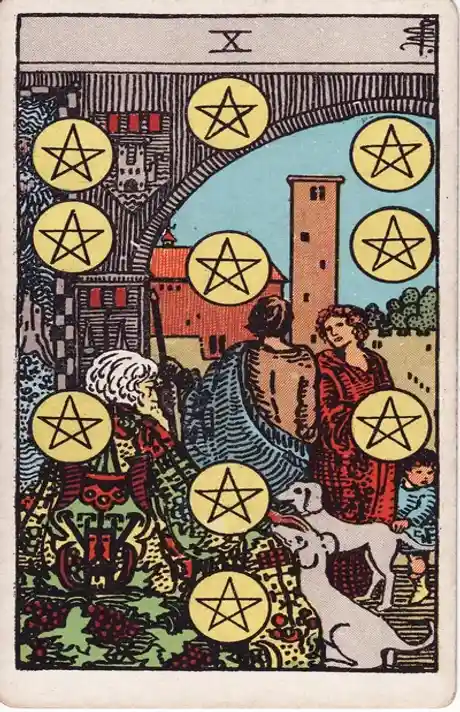
In the familiar Rider-Waite-Smith illustration, an older figure, other family members, an archway, and ten pentacles form a scene of shared life. A useful reading can begin with that contrast between one person’s experience and the larger household. Ask what is being maintained, who contributes, and whether everyone has a place within the structure.
The image does not require a conventional family model. Depending on your question, belonging might mean chosen family, close friends, a cooperative project, or a community you help maintain. Reading the card only as marriage, children, or inherited money can overlook the situation the querent actually described.
Pentacles are traditionally linked with Earth, and some esoteric systems connect this card with Mercury in Virgo. Those are interpretive correspondences within tarot traditions, not scientific explanations or evidence that a specific event will happen. You can work with the card’s everyday themes without using astrology at all.
Notice the distinction between a symbol and an observation. “The card raises the theme of support” is an interpretation. “My household has agreed how to divide a task” is an observation. Keeping those separate makes the reading easier to evaluate and less likely to become a story you assume must be true.
Upright Meaning
The Ten of Pentacles upright often represents the support that develops through consistency: reliable relationships, shared responsibilities, useful skills, or traditions that make daily life easier. Material resources are one part of this picture, but stability can also mean knowing whom you can ask for help or having a routine that fits your needs.
In a practical reading, ask what already provides dependable support. Are responsibilities understood? Do people have a say in decisions that affect them? Does your idea of success allow room for the people and activities you value?
The card is traditionally associated with inheritance and family wealth. That association does not establish that money is coming or that a property decision will succeed. For an actual financial or legal question, use documents, verified information, and qualified advice rather than a card draw.
Ten of Pentacles Reversed Meaning
The Ten of Pentacles reversed can suggest a mismatch between the security you are expected to want and the life you want to build. It may invite you to review family expectations, shared obligations, or the cost of maintaining an appearance of success. A reversal is not proof of conflict or a warning that a loss is about to occur.
One useful distinction is between a practical problem and a difference in values. A practical problem might be an unclear household agreement that can be discussed. A difference in values might be discovering that independence matters more to you than continuing a family tradition. Check which, if either, fits your situation before applying the interpretation.
The reversed card can also support a constructive question: “Which parts of my inheritance, whether material or emotional, do I want to keep?” You do not have to reject every tradition to reconsider one expectation.
Ten of Pentacles in Love and Relationships
Upright in love: This card invites discussion of shared values, everyday dependability, and what a lasting partnership would look like to both people. It can be a useful prompt for conversations about home, community, family involvement, and responsibilities. It does not confirm that someone wants marriage or that a relationship will last.
Reversed in love: Consider whether outside expectations or different definitions of commitment need clarification. Do not assume family disapproval, hidden financial problems, or an impending breakup from the card alone. Ask an open question and compare the answer with observable behavior.
If you are single, the same themes can help you identify what belonging and stability mean to you without predicting who you will meet. In questions about someone’s feelings, the Ten of Pentacles cannot reveal their private thoughts; direct communication is more informative.
For a relationship-focused question, use the free love tarot reading. A helpful question is: “What expectations about commitment would be useful for me to clarify?”
Career and Money
Upright: Reflect on the systems that support sustainable work: clear responsibilities, transferable skills, dependable processes, and realistic long-term goals. The card may be relevant to a question about family business or shared resources, but it is not a recommendation to buy property, accept an offer, or make an investment.
Reversed: Review the assumptions behind a plan before treating it as secure. Are you choosing a path because it suits you, or because it matches someone else’s definition of success? What factual information would help you evaluate an obligation or opportunity?
The career tarot tool can help organize a reflective question. Use a budget, contract review, or qualified professional for decisions involving your actual money and legal commitments.
Health and Wellbeing
In a wellbeing reflection, the Ten of Pentacles can prompt you to consider practical support, manageable routines, and access to help. It cannot diagnose a condition, identify hereditary illness, predict longevity, or establish that you are healthy. A reversed card does not change that limit. Bring symptoms or family medical-history questions to a qualified clinician.
Ten of Pentacles: Yes or No?
TarotWise classifies the Ten of Pentacles as Maybe. Yes-or-no associations vary between readers; this is a symbolic convention, not an objective forecast. Here, the emphasis is on conditions that need clarification, such as shared expectations and practical support.
Upright can invite consideration of what supports a lasting plan. Reversed can invite a closer look at assumptions or obligations. Neither is a substitute for consent, a financial assessment, or a decision you make using real information.
Use the free yes-or-no tarot tool for a focused reflection, or a three-card spread when the question needs more context than a single symbolic leaning.
Card Combinations
Ten of Pentacles and The World: Compare continuity with completion. What has reached a useful milestone, and what would help sustain it? See The World meaning for the completion theme.
Ten of Pentacles and Four of Wands: Compare long-term belonging with celebration and shared space. This can prompt reflection on how everyday support relates to moments of connection; it does not announce a wedding. See Four of Wands.
Ten of Pentacles and The Tower: Compare established structures with the need to question them. Identify an assumption you can verify rather than predicting a crisis. See The Tower meaning.
A Practical Reflection
Reading This Card in Context
- Restate your actual question before selecting a meaning. A question about belonging is different from a question about a work agreement, even if both involve security.
- Note the orientation and any assigned position. A reversed card in a “challenge” position is a prompt to examine an issue, not an additional guarantee that something will go wrong.
- Choose one or two relevant themes. You do not need to apply every keyword, especially strong terms such as inheritance or family disputes, when there is no matching context.
- Identify one observation or conversation that could clarify the question. Separate what you already know from what you are only considering.
- Revisit your notes after that action. Ask whether the exercise clarified your thinking, rather than searching for events that might prove a prediction.
Distinguishing Similar Cards
The Nine of Pentacles commonly emphasizes personal independence, enjoyment, and self-sufficiency. The Ten shifts the reflective focus toward shared structures and continuity. This is a difference in emphasis, not a claim that one lifestyle is better or that the Ten promises more money.
The Ten of Cups is often read through emotional connection and shared happiness. The Ten of Pentacles brings practical support, commitments, and material arrangements into view. When both appear, you might ask how the way people feel relates to how everyday responsibilities are handled. Do not assume a relationship has both qualities just because the cards appeared together.
Write down one thing that currently helps you feel supported, one expectation you would like to clarify, and one question you can answer with real information. This is a reflection exercise, not a forecast or a requirement to change your relationships or finances.
Record the question, orientation, and your observations in a tarot journal. Later, review what you learned from your actions and conversations rather than treating the reading as proof that an event was destined to happen.
Frequently Asked Questions
What does the Ten of Pentacles tarot card mean?
The Ten of Pentacles is a Minor Arcana card from the Suit of Pentacles. Its core meanings include wealth, inheritance, legacy, family. Read the upright or reversed position together with the question and surrounding cards.
Is the Ten of Pentacles a yes or no card?
The Ten of Pentacles generally gives a "maybe" answer in a yes or no tarot reading. The question, card orientation, and surrounding cards can refine that answer.
What does the Ten of Pentacles reversed mean?
The Ten of Pentacles reversed is associated with financial failure, family disputes, instability, loss of legacy. Apply these themes to the specific area of the reading, such as love, career, finances, or personal growth.
What suit does the Ten of Pentacles belong to?
The Ten of Pentacles belongs to the Suit of Pentacles, which is associated with the element of Earth. This suit deals with wealth, health, and material concerns.