Three of Pentacles Tarot Card Meaning
The Three of Pentacles is commonly read as a symbol of collaboration, practical learning, and shared standards. Upright, it invites attention to how different contributions fit together. Reversed, it can prompt a review of roles, feedback, or expectations. Neither orientation tells you what another person thinks, proves that a team is failing, or guarantees that effort will be rewarded.
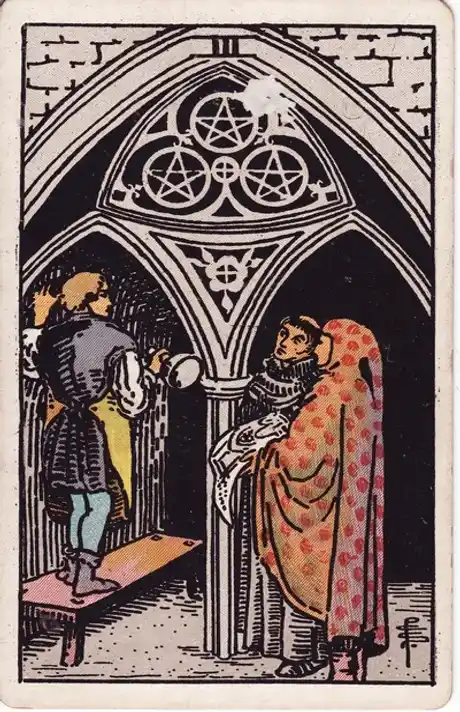
In Rider-Waite-Smith imagery, a craftsperson works beneath a decorated arch while two figures nearby consult a plan. The scene provides a useful visual anchor: making something involves a design, practical skill, and discussion. You do not need to assign those figures to real people in your life. Use the image to ask which parts of an actual process need attention, rather than treating it as evidence about a colleague or partner.
Three of Pentacles Upright vs Reversed
| Reading angle | Upright reflection | Reversed reflection |
|---|---|---|
| Cooperation | How can different skills contribute? | Are roles or expectations unclear? |
| Quality | What does a useful result look like? | Are people judging the result by different standards? |
| Learning | Where could feedback support practice? | Is feedback missing, confusing, or difficult to use? |
| Participation | What can each person realistically offer? | Is the workload worth discussing or adjusting? |
These are questions to compare with observable circumstances, not facts revealed by the draw. A reversed card is not a verdict on anyone’s competence. An upright card is not proof of approval, harmony, or a successful outcome.
Upright Meaning
Upright, the Three of Pentacles draws attention to the process of making a contribution. A useful interpretation is not simply “work harder” or “find a team.” It is to examine how a task moves between planning, doing, and checking. Those functions might involve several people, or one person working independently. The card does not require you to be employed, studying, or already involved in a group project.
If a collaboration is relevant, consider whether everyone understands the intended result. One person may prioritize speed while another values detail. Naming that difference gives you something specific to discuss; drawing an upright card does not establish that the difference has already been resolved. Ask for examples of useful work, an agreed next step, or a realistic opportunity for feedback.
The craftsmanship theme can also be relevant to learning. Instead of judging yourself as talented or untalented, choose a small aspect of a skill that you can observe. What changed between two attempts? Which instruction was useful? What still needs clarification? This makes the reflection about a process you can inspect, without promising mastery or recognition.
Working independently is not automatically the wrong choice. You may need privacy, a limited scope, or time to decide whether outside input is appropriate. The question is whether the way you are working suits the task and your circumstances, not whether you can reproduce the group pictured on the card.
Three of Pentacles Reversed Meaning
The Three of Pentacles reversed, also searched as 3 of Pentacles reversed, is often interpreted through themes of misalignment, uneven participation, or difficulty using feedback. It can also suggest reviewing the way a project is organized. These possibilities are alternatives to investigate, not a diagnosis that every collaboration around you is broken.
Unclear roles: If you are sharing a task, check who owns the next action and who needs to review it. An unanswered question about responsibility is more useful evidence than a suspicion that someone does not care. A short written agreement may help make expectations visible; it does not guarantee cooperation.
Different standards: Before labeling work as poor quality, ask which criteria were actually agreed. A first draft, practice exercise, and finished deliverable serve different purposes. If there is no shared standard, the reflection can begin with defining one rather than assigning blame. If standards are clear, compare the work with specific examples rather than using the card as a judgment.
Feedback or workload gaps: A reversal may invite questions about whether input is available, understandable, and proportionate to the task. If there is no real problem to identify, do not invent one. You can treat the card as a routine check of your process, or acknowledge that its usual interpretation does not fit this situation. Tarot does not require forcing every theme into your biography.
Love & Relationships
Upright in love: The collaboration theme can be applied to shared responsibilities, communication, or making room for different needs. If you have a partner and a conversation is appropriate, choose one practical topic that both of you can discuss. The card does not reveal commitment, attraction, or readiness on another person’s behalf. If you are single, it does not predict meeting someone at work or through study.
Reversed in love: Consider whether a real disagreement concerns effort, expectations, or communication, without assuming that one exists. The card cannot establish a third party, infidelity, or an unequal relationship. Ask what has actually been said or done and what remains uncertain. Where contact is unwelcome or unsafe, respect that boundary instead of treating collaboration as an instruction to reach out.
For a question about your own approach, try a free love tarot reading. Ordinary readings do not require an account. Keep the question focused on choices available to you rather than asking the cards to disclose someone else’s private thoughts.
Career & Finances
Upright in career: Use the card to reflect on practical learning, project planning, or seeking relevant feedback. If you are considering training, compare its cost, content, and suitability with your goals. If you are employed, ask for concrete performance expectations rather than assuming your work has been recognized. If you are exploring work options, the card does not establish that a job offer or supportive team is waiting.
Reversed in career: Review instructions, responsibilities, and available support before concluding that a workplace is dysfunctional. If you already have evidence of a problem, document the specific issue and consider appropriate professional advice. A tarot draw is not a reason to resign, confront a colleague, or reject an offer. A career tarot reflection can organize questions, but decisions still need real information.
For money questions, neither orientation predicts returns, income, or the value of an investment. Check budgets, written agreements, and qualified financial guidance where relevant. Paying for a course or joining a venture is not made safer by an upright card.
Health & Wellness
The collaboration imagery can be a reminder to prepare questions for qualified healthcare professionals. It cannot diagnose a condition, assess treatment quality, or establish that clinicians are communicating poorly. A reversed card is not evidence that your care is inadequate or that you have failed to follow advice.
Base health decisions on symptoms, medical evidence, and professional guidance. Do not delay urgent care or change treatment because of this card. If you have a genuine concern about care, describe the concern directly to an appropriate professional rather than using the reading to infer what is happening.
Yes or No
TarotWise classifies the Three of Pentacles as a symbolic Yes. This is a reading convention, not a prediction or approval to take a particular action. It can support reflection on participation and preparation. Reversed, pause to review the conditions behind the question rather than assuming either failure or success. The yes or no tarot tool is for reflection, not financial, medical, or legal decisions.
Key Combinations
Three of Pentacles + The Hierophant: Compare practical cooperation with formal teaching or established methods. Is a rule useful for this task, and is the person offering guidance appropriately qualified? The combination does not prove that an institution or teacher is right for you.
Three of Pentacles + Eight of Pentacles: The Three highlights coordination; the Eight of Pentacles emphasizes practice and attention. Consider which part of a real task needs discussion and which part needs an individual attempt. Neither card guarantees recognition or mastery.
Three of Pentacles + The Tower: Compare the process you are using with assumptions that may need examination. Do not turn this pairing into a prediction of dismissal, organizational collapse, or an argument. Identify a verifiable concern before deciding that anything needs rebuilding.
How to Read This Card in Context
- Keep the question and orientation visible. A work-related image does not automatically turn a general question into a career reading.
- Use a position only if your spread assigned it. A free draw has no automatic past-present-future timeline.
- Separate a card theme from an observed fact. Write down what you know, what you assume, and one question you could check.
- Choose an optional, manageable activity, such as clarifying one requirement. Check real deadlines before delaying any obligation for a reflection exercise.
For an illustrative example, imagine you are already preparing a shared presentation and draw this card reversed. You might compare the brief with each contributor’s understanding of it, then ask whether the intended audience and length are clear. That is different from concluding that a teammate is unskilled or uncooperative. The example begins with a real task supplied by the reader; the card does not invent that task.
Record your question, orientation, observations, and later feedback in a tarot journal. For another perspective, use a three-card spread with explicit roles or draw cards freely without assigning a timeline. Treat each reading as a prompt for reflection, and let actual circumstances determine whether its suggestions are useful.
Frequently Asked Questions
What does the Three of Pentacles tarot card mean?
The Three of Pentacles is a Minor Arcana card from the Suit of Pentacles. Its core meanings include teamwork, craftsmanship, collaboration, skill. Read the upright or reversed position together with the question and surrounding cards.
Is the Three of Pentacles a yes or no card?
The Three of Pentacles generally gives a "yes" answer in a yes or no tarot reading. The question, card orientation, and surrounding cards can refine that answer.
What does the Three of Pentacles reversed mean?
The Three of Pentacles reversed is associated with lack of teamwork, mediocrity, misalignment, poor quality. Apply these themes to the specific area of the reading, such as love, career, finances, or personal growth.
What suit does the Three of Pentacles belong to?
The Three of Pentacles belongs to the Suit of Pentacles, which is associated with the element of Earth. This suit deals with wealth, health, and material concerns.