What Is Tarot Reading?
Tarot reading is the practice of using a 78-card deck to gain insight, guidance, and perspective on life situations. The deck consists of 22 Major Arcana cards representing life’s major themes and spiritual lessons, and 56 Minor Arcana cards divided into four suits that reflect everyday experiences.
Tarot is a symbolic reflection practice, not a reliable way to establish future events, diagnose a condition, or know another person’s private thoughts. You can use a card’s theme to explore a question while checking your interpretation against real information.
How to Use Tarot Cards: Your First Reading
You can start with a physical deck or a free online card draw. A special room, ritual, or paid reading is not required. On TarotWise, ordinary draws and free interpretations do not require an account; account-based services are separate.
- Choose one question. Try “What should I consider before responding?” rather than asking a card to decide for you. Include the situation and any real deadline that matters.
- Choose the roles before drawing. For one card, leave the role open or choose a focus such as “a perspective to consider.” For several cards, write down the intended positions first.
- Shuffle and draw. With physical cards, use a shuffle that does not damage the deck. With an online tool, select the number of cards and use its draw control.
- Record the actual result. Note the card name, upright or reversed orientation, and any assigned position. Do not silently turn a reversed card upright because its meaning feels easier.
- Observe, then look up the meaning. Describe a detail you can see before consulting the card meanings library. Separate the picture, its traditional theme, and your personal association.
- Connect the theme to your question. Ask whether it fits your circumstances. A card can suggest a useful question without proving an answer about your life.
- Choose one small reflection. For example, list the information you still need before replying. A reflection exercise should not delay urgent action or make you miss an obligation.
For a ready-made starting point, try daily tarot for one card or the three-card spread for a structured reading. You can also compare beginner tarot spreads before choosing a format.
Understanding the Tarot Deck Structure
Major Arcana (22 Cards)
The Major Arcana cards depict broad symbolic themes. Examples include The Fool and beginnings, The Tower and disruption, and The World and completion. These associations do not establish that a major event is happening to you. The number of Major Arcana in a draw does not measure the importance of your problem.
Minor Arcana (56 Cards)
The Minor Arcana is divided into four suits, each associated with an element and area of life:
- Wands (Fire): Creativity, passion, ambition, and action
- Cups (Water): Emotions, relationships, intuition, and feelings
- Swords (Air): Thoughts, communication, conflict, and truth
- Pentacles (Earth): Material matters, career, finances, and health
Each suit contains cards numbered Ace through Ten, plus four Court Cards (Page, Knight, Queen, King) representing people or personality aspects.
How to Prepare for a Reading
Setting the Space
Create a calm, focused environment for your reading. This does not require candles or crystals (though you can use them if you like). What matters is that you feel centered and present. Take a few deep breaths, clear your mind, and set an intention for the reading.
Formulating Your Question
The quality of your question shapes the quality of your reading. Good tarot questions are:
- Open-ended: “What do I need to know about…” rather than “Will I…”
- Focused: Address one topic at a time
- Empowering: Frame questions around what you can do or understand, not what will happen to you
Use this list of questions to ask tarot cards when you need focused prompts for love, career, decisions, self-reflection, or a daily pull.
Shuffling and Drawing
There is no single correct way to shuffle tarot cards. Some readers riffle shuffle, some spread cards on a table and mix them, others cut the deck into piles. What matters is that you feel connected to the process. When you feel ready, draw your cards.
Reading Your First Spread
The One-Card Draw
A one-card draw is a manageable starting point. Try “What perspective could I consider today?” Record the card and decide whether its theme gives you a useful question. You do not need to find a matching event later to make the exercise worthwhile.
The Three-Card Spread
Choose three positions before drawing. Possible reflective roles include:
- Past / Present / Future — Past context you can verify, current observations, and conditional possibilities
- Situation / Action / Outcome — A situation to examine, an optional action, and possible consequences to consider
- Mind / Body / Spirit — A holistic check-in
Reading the Cards Together
Individual card meanings matter, but the real insight comes from reading cards in relationship to each other. Notice:
- What role, if any, did you assign to each card before drawing?
- Are there repeated suits or numbers?
- Do the cards support or contradict each other?
- What is your gut reaction to the overall spread?
Without assigned positions, a free draw is a set of complementary perspectives. Left-to-right display order alone does not create a past, present, and future timeline. An assigned future position is still a reflection topic, not proof of an upcoming event.
How to Read Tarot Card Combinations
A tarot card combination is the meaning created when two or more cards are read as one message. Start with each card’s core theme, then ask how the cards modify one another in the order and positions where they appeared. The goal is not to memorize every possible pair. It is to identify the clearest relationship between the cards in this reading.
Use this sequence:
- Name each card’s theme. For example, The Tower can symbolize disruption, while The Star can symbolize hope. Neither card establishes a personal event or guarantees recovery.
- Read the spread position. A card in an obstacle position behaves differently from the same card in an advice position.
- Look for reinforcement or tension. The Lovers with the Two of Cups can invite reflection on connection without revealing whether feelings are mutual. The Emperor with the Fool can contrast structure with experimentation.
- Notice repeated suits, elements, and numbers. Several Cups emphasize emotion and relationships; several Swords emphasize thought, communication, or conflict.
- Write one combined sentence. For the Tower and Star, try: “What support would help me consider a change?” This connects the themes without promising that disruption will lead to improvement.
Powerful tarot card combinations are not automatically positive or negative. Their usefulness comes from how clearly the cards help you examine a question. Follow the position labels actually shown in your chosen spread, then open each card’s meaning for additional context.
A Worked One-Card Example
Suppose you ask, “What could help me prepare for a conversation?” and draw the Eight of Pentacles upright. This is an illustrative example, not a prediction or a reported customer experience.
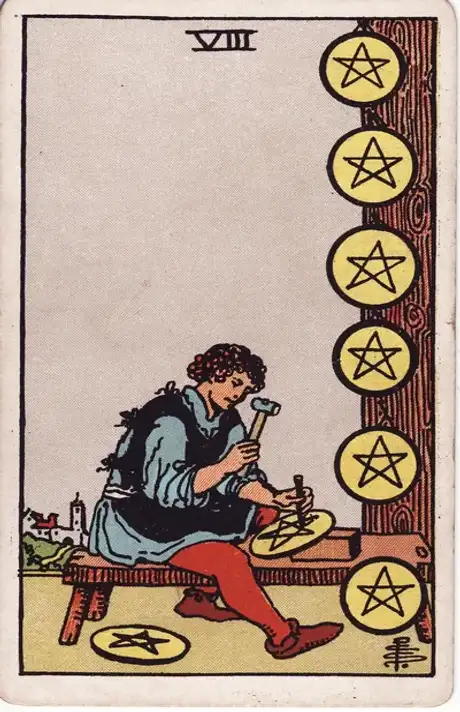
- Observation: The card depicts someone working carefully at a repeated task.
- Traditional theme: Practice and attention to detail.
- Reflection: “Which point could I explain more clearly?”
- Optional action: Write a short outline of what you want to ask before the conversation.
The card does not show how the other person will respond. If drawn reversed, consult the reversed meaning instead; you might explore the difference between useful preparation and overworking the details. Neither orientation guarantees a successful conversation.
Developing Your Intuition
Trust Your First Impression
When you flip a card, notice your immediate response before consulting a guidebook. Treat it as an association to explore, not automatically the most accurate explanation. A useful reading leaves room to revise an interpretation that does not fit the facts.
Learn the Symbols
Tarot cards are rich with visual symbolism. Colors, animals, landscapes, and objects all carry meaning. Over time, you will develop your own symbolic vocabulary that goes beyond textbook definitions.
Keep a Tarot Journal
Record the question, cards, positions, orientations, and your interpretation. Later, note what you learned, including details that did not fit your initial interpretation. This helps you examine your thinking; it does not prove predictive accuracy. The tarot journal template provides fields and reflection prompts without requiring another reading.
Common Beginner Mistakes
Over-Relying on Guidebooks
Guidebooks are helpful starting points, but they cannot replace your personal connection to the cards. Use them as references, not scripts.
Asking the Same Question Repeatedly
If an answer feels uncomfortable, drawing repeatedly until a preferred card appears can make it harder to reflect. You do not have to accept the first interpretation as true either. Pause the exercise, check the real situation, or return with a clearer question when that is useful.
Fearing “Negative” Cards
Cards like Death, The Tower, and the Ten of Swords can look alarming. Their traditional themes include change, disruption, and difficult endings, but drawing them does not prove that a loss will happen or that a danger has passed. Read the symbolism in context. For health, safety, legal, or financial concerns, use relevant evidence and qualified help rather than a card verdict.
Ignoring Reversed Cards
Reversed cards are drawn upside-down. Readers use different conventions: a reversed theme may be internal, blocked, exaggerated, or changing. Look up the specific card rather than treating every reversal as bad. Some readers choose an upright-only practice before drawing; there is no requirement to use reversals. When a tool supplies a reversed result, keep that orientation when interpreting or saving it.
Frequently Asked Questions
Can I read tarot cards without memorizing all 78 meanings?
Yes. Begin with one card, observe its image, and consult a meaning guide. Record the difference between the traditional meaning and your own association. Familiarity can grow through practice without treating recall as proof of predictive ability.
Do I need to use reversed cards?
No. Choose your convention before a physical draw. If you use a tool that includes reversals, interpret the displayed orientation instead of replacing it afterward. A reversed card is not automatically a negative answer.
How many cards should a beginner draw?
One card is enough for a first reflection. Three cards can help compare distinct perspectives if you define their positions before drawing. More cards add information to interpret; they do not make the answer more certain.
Can I try tarot online without signing up?
Yes. Ordinary card draws and free interpretations on TarotWise are available without an account. Start with the free draw or daily tool linked above. Tarot remains a reflection exercise whether the deck is physical or digital.
Next Steps in Your Tarot Journey
Once you are comfortable with basic readings, explore:
- Larger spreads like the Celtic Cross for complex situations
- Themed readings like love tarot or career-focused spreads
- Reading for others to develop your interpretive skills
- Studying card combinations to understand how cards interact
Tarot is a lifelong practice. There is always more to discover, and your relationship with the cards will deepen with every reading you do.